



Table of Contents
You’re balancing ticket queues, invoice approvals, cyber risk reviews, vendor renewals, and another leadership request to modernize without adding friction. No room for guesswork.
Paul Pagani, CISO, vCISO, Cybersecurity Expert at Edgeworx Solutions, notes: “Start by connecting tickets, risks, invoices, and roadmap decisions in one review rhythm, because isolated fixes rarely improve service quality or executive visibility.”
These managed security and AI challenges matter because security and intelligent automation touch every endpoint, cloud environment, and customer handoff. When 69% of respondents say their team lacks the skills needed to manage complex cloud applications proficiently, internal teams need expert co-management, not more operational clutter.
At Edgeworx Solutions, we work as a security-first partner and extension of your internal team, pairing strategic CISO-level leadership with tactical cyber and AI execution so you can modernize, protect operations, and scale safely.
Why Managed Services Challenges Show Up In Everyday Workflows
Service issues rarely begin as clean “IT problems.” They show up as a purchase request waiting for approval, a printer ticket blocking a front counter, a missed customer call, or a department head asking why the same issue returned.
Those symptoms raise operating costs, slow response times, and leave executives making decisions from incomplete service data. A ticket queue, endpoint request, or permit call can all expose the same operating gaps.
-
Alert Fatigue & Signal Overload: Unfiltered security events overwhelm internal resources and lead to missed critical threats.
-
Unclear Security Governance: Ambiguous ownership delays vulnerability remediation, third-party risk assessments, and compliance sign-offs.
-
Disjointed Customer Channels: Poorly integrated or unmonitored AI tools create dead ends, hallucinations, or inconsistent customer communications.
-
Lagging Risk Visibility: Delayed threat and compliance reporting weakens strategic planning and clouds cybersecurity budget discussions.
We connect those workflow symptoms to managed capabilities leaders can act on, including governance, cybersecurity planning, service desk workflows, and roadmap development.
Where IT Managed Services Provider Challenges Affect Growth Plans
These IT managed services provider challenges become more expensive when support activity is disconnected from executive priorities.
-
Unclear Security Ownership Delays Modernization
Stalled cloud migrations, unreviewed third-party risks, and missed compliance deadlines often trace back to fragmented security roles. Small delays compound into unmitigated exposure and stalled commercial deals. -
Reactive Security Limits Strategic Planning
Putting out threat fires keeps the lights on, but it doesn’t build long-term cyber resilience. Growth requires continuous threat modeling, capacity management, and executive-level security direction working in tandem. -
Security Stretches Internal Teams Thin
Cybersecurity teams are overworked, 24% face layoffs while 67% report lacking the personnel to achieve their security goals. Security controls must fit seamlessly into real business workflows without paralyzing productivity. -
Reporting misses business impact
When 71% of MSPs view customer acquisition as their biggest challenge, reporting needs to show operational value through trends, sentiment, tickets, and invoices. -
Integrations create hidden drag
With 39% reporting setbacks adapting to advanced security technologies, phone systems, AI tools, security platforms, and internal systems need disciplined integration.
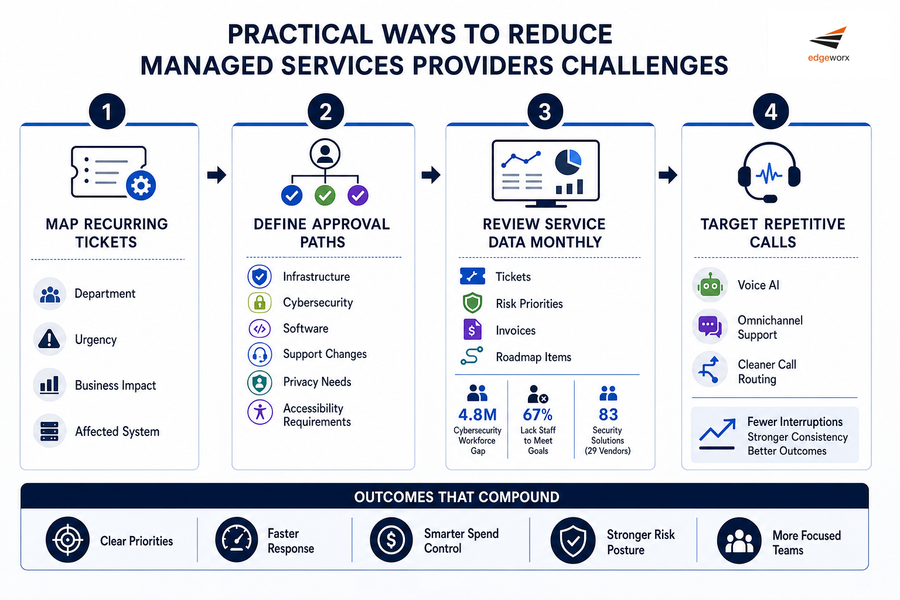
Practical Ways To Reduce Managed Services Providers Challenges
Change is hard when teams improve systems while live operations keep moving. Reducing managed services providers challenges starts with turning service activity into a reviewable operating rhythm.
-
Map recurring tickets: Sort requests by department, urgency, business impact, and affected system so a password issue, network outage, and finance approval delay don’t receive the same treatment.
-
Define approval paths: Clarify who signs off on infrastructure, cybersecurity, software, support changes, privacy needs, and accessibility requirements before renewal deadlines arrive.
-
Review service data monthly: Compare tickets, risk priorities, invoices, and roadmap items in one review. This matters when the cybersecurity workforce shortage is estimated at 4.8 million, and 67% say they lack staff to meet goals.
-
Target repetitive calls: Identify where Voice AI, omnichannel support, and cleaner call routing can reduce interruptions and improve response consistency, especially when organizations already juggle 83 different security solutions from 29 vendors.
Related Managed IT Insights
How To Turn IT Managed Services Challenges Into Operating Maturity
Operational maturity means support, cybersecurity, customer engagement, and executive planning operate from one manageable model instead of scattered fixes.
-
Faster response across channels
We help connect ticket discipline, Voice AI, and omnichannel workflows so service requests move through defined queues, call flows, and escalation paths. -
Lower operating waste
Repeat calls, duplicate tickets, and manual follow-ups drain capacity. Our monthly reviews surface patterns leaders can act on, from recurring endpoint issues to content gaps in customer responses. -
Clearer executive decisions
Through Edgeworx-as-a-Service and C-Level Managed Services, we connect roadmap assessments to budget priorities, project timing, and skills gaps. -
Stronger risk governance
Cybersecurity planning, privacy, accessibility, and compliance workflows support resilience, especially when organizations manage 83 different security solutions from 29 vendors. -
Scalable service capacity
Managed support fills gaps without rushed hiring. Around 30% report partial consolidation, 19% have most infrastructure under one platform, and 10% have achieved full consolidation, so roadmap discipline matters.
Modernize IT Without Adding Friction
Turn managed services challenges into clearer priorities, stronger security, and smoother service delivery with Edgeworx Solutions.
Deploying Managed AI To Elevate Customer Experience & Response
Customer-facing communication gaps quickly become operational risks when Voice AI, omnichannel routing, knowledge bases, and security safeguards aren’t synchronized. We deliver and manage Voice AI and Omnichannel Managed AI Services (powered by SoundHound) as an operational force multiplier, strictly governed for security, accuracy, and brand alignment.
Unanswered customer calls, routing errors, order inquiries, and sentiment trends provide crucial operational intelligence. When systematically analyzed each month, teams can quickly remediate missing content, correct confusing conversational flows, and refine customer interactions.
That data review matters because customer experience, staffing, and operating cost are connected.
-
Call flows get cleaner: We integrate with existing phone systems and call routing so common questions reach the right answer or queue faster.
-
Content gaps surface: Monthly reviews identify missing answers, outdated scripts, and confusing responses before they create repeat contacts.
-
Sentiment informs action: Customer response trends guide staffing, training, and service improvements across frontline workflows.
Building A Roadmap Around IT Service Delivery Challenges
Addressing managed services challenges through a roadmap helps leaders connect modernization work to risk, cost, and service quality. We use assessments, roadmap services, and virtual C-suite support to help prioritize what matters now and what can wait.
Roadmaps keep modernization from turning into scattered purchases across tickets, invoices, renewals, and cyber control gaps. Sequence matters.
-
Assess current workflows: Review tickets, approvals, invoices, systems, cyber controls, network support needs, and service channels before setting priorities.
-
Rank business risk: Prioritize security, compliance, uptime, privacy, accessibility, and customer-facing workflows, especially as supply chain and third-party breach incidents have been quadrupling.
-
Set phased investments: Align modernization with budget cycles, staffing capacity, and operational readiness while the workforce shortage is 4.8 million.
-
Review progress monthly: Track service performance against executive priorities, noting that 39% report setbacks adapting to advanced security technologies.
A More Accountable Path Forward
Managed services success depends on clear workflows, stronger risk controls, better customer response, and roadmap discipline that leaders can see in tickets, invoices, reviews, and service data.
For leaders comparing options, IT managed services provider challenges should be evaluated through accountability, security planning, service visibility, and business outcomes. At Edgeworx Solutions, we help assess current workflows, align managed IT and cybersecurity planning, and build a practical roadmap supported by monthly review discipline.
Our team works as a trusted advisor and extension of your internal team, bringing collaboration, ethics, agility, and practical execution to cyber resilience and day-to-day operations, from the first ticket queue review to the next leadership modernization request.