



Table of Contents
-
How To Choose Managed Services Provider For Daily Operational Fit
-
Managed Services Selection Criteria That Reveal Real Maturity
-
How To Choose Managed Security Services Without Confusing Scope
-
Questions To Ask During MSP Discovery Before Comparing Price
-
Technical Questions To Qualifying MSP Candidates For Security And Applications
-
Managed Services Vendor Selection Criteria For A Stronger Working Relationship
Tickets pile up before a permit deadline while a restaurant phone system misses orders and an approval workflow stalls after an integration fails. The question of how to choose managed services provider support affects workflows, risk visibility, customer response, and leadership decisions. It also overlaps with how to choose managed security services, since 60% named cybersecurity as the top challenge that led them to an MSP.
Alan McFarland, Strategic Advisor for Digital Transformation at Edgeworx Solutions, notes: “Start with daily work, then map risk, ownership, and reporting before comparing tools or monthly pricing.”
How To Choose Managed Services Provider For Daily Operational Fit
An MSP should be judged by real work, not by service-menu length. The managed services vendor selection criteria should connect scope to fewer repeat tickets and cleaner approvals. They should also support better phone flow, stronger documentation, and risk reviews with clear next steps.
Key examples of this include:
-
Recurring ticket patterns: The review should show how login, printer, and application issues become root-cause fixes.
-
Approval workflow breaks: The evaluation should confirm who owns broken routing between finance, managers, and records.
-
Phone system flow: The review should cover call queues, after-hours routing, missed calls, and handoffs.
-
Risk review outputs: Strong reporting should show documented owners, timelines, and decisions.
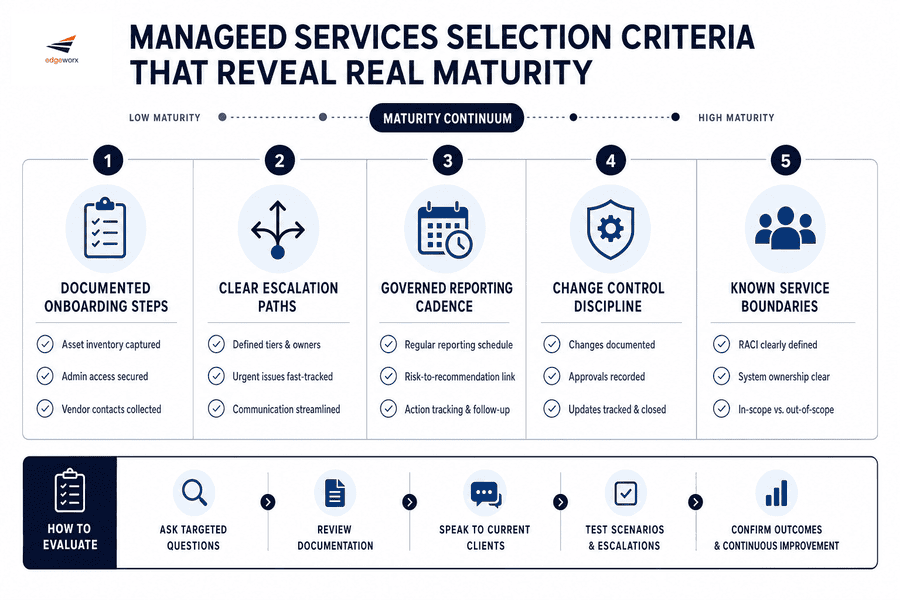
Managed Services Selection Criteria That Reveal Real Maturity
Maturity shows up after the proposal. Onboarding, escalations, reporting, and governance must meet real deadlines. With 39% of MSPs reporting major setbacks adapting to advanced security technologies, the questions to ask an MSP should test the operating model behind the promise.
Examples of this idea are:
-
Documented onboarding evidence: Assets, admin access, and application owners should be captured early.
-
Clear escalation paths: Urgent payroll, permitting, or customer-facing issues should not drift.
-
Governed reporting rhythm: Reviews should connect activity, risks, recommendations, and decisions.
-
Change control discipline: Updates should be scheduled, approved, tested, and recorded.
-
Service boundary clarity: Each system, vendor, and unresolved risk should have a clear owner.
How To Choose Managed Security Services Without Confusing Scope
Managed IT services keep devices and users productive. They also support networks, applications, and daily workflows. Managed security services focus on identity controls, backups, endpoint protection, and alerts. They also cover logging, incident readiness, and evidence for obligations.
The technical questions to qualifying MSP candidates should separate operational support from security obligations. The distinction matters because outsourcing execution does not transfer business risk, especially when IBM reported the global average cost of a data breach reached USD 4.99 million in 2026.
When a municipality prepares cyber insurance evidence, it needs proof that privileged accounts and backup tests are reviewed. Endpoint alerts and exceptions also need review. The provider should explain what is monitored, reported, escalated, and still approved by leadership.
Explore Managed IT Services
MSP Qualifying Questions That Expose The Operating Model
Good questions reveal how work gets done after the agreement is signed. The questions to ask during MSP discovery should test follow-through and ownership, especially since vulnerability exploitation as an initial access step grew by 180%.
Key examples of this include:
-
How is onboarding documented? The answer should confirm inventory, vendor contacts, and application owners. It should also include admin access and user communication.
-
Who manages patch timing? The answer should show how maintenance windows and exceptions are approved.
-
How are backups tested? The answer should include restore evidence, not just dashboard status.
-
Who reviews identity access? The review should include privileged accounts, departures, and service accounts.
-
What reaches executive review? Reports should show risks, actions, and decisions. They should also show budget needs and recommendation status.
Questions To Ask IT MSP Teams About Workflow Improvement
A provider should understand workflows before prescribing tools. Strong managed services selection criteria show how support affects tickets and approvals. They should also address invoices, phone systems, and application support. Customer sentiment and data gaps should be part of the review.
Examples of this idea are:
-
Ticket intake mapping: The review should identify where requests start, who triages them, and where delays repeat.
-
Invoice routing checks: The evaluation should confirm support for breaks between finance systems, email, folders, and manager queues.
-
Phone flow reviews: The review should include missed calls, queues, after-hours routing, and Voice AI handoffs.
-
Content gap tracking: Monthly review should cover customer questions, sentiment, and unresolved answers.
Questions To Ask An MSP About Contracts And Governance
Contract terms shape daily accountability. They define response targets, exclusions, change approvals, and data ownership. They also cover termination support, security obligations, review cadence, and reporting. Since NIST Cybersecurity Framework 2.0 organizes outcomes around 6 core functions, governance belongs in MSP qualifying questions, not just legal review.
Key examples of this include:
-
SLA definition details: Response times should tie to priority, business impact, coverage, and escalation rules.
-
Exclusion clarity checks: Extra costs should be clear before vendor coordination or project handoffs.
-
Data ownership rights: Access should include documentation, logs, configurations, reports, and transition records.
-
Review cadence evidence: Quarterly reviews should cover value, risks, budget, open decisions, and recommendations.
Choose an MSP That Fits Daily Work
Use your MSP evaluation to improve tickets, workflows, security scope, and reporting with Edgeworx Solutions.
Questions To Ask During MSP Discovery Before Comparing Price
Switching providers or formalizing managed services takes planning. Onboarding, tool changes, knowledge transfer, and user communication affect the person waiting on a password reset and the manager approving a purchase order. The process often starts alone, with B2B buyers spending 83% of their journey researching independently. Still, questions to ask IT MSP teams should test collaboration and operating fit before price leads.
Examples of this idea are:
-
Sequence the transition: The plan should identify high-risk systems, users, vendors, and applications first.
-
Plan communication early: User updates should explain ticket channels, response expectations, timing, and day-one changes.
-
Validate key integrations: Discovery should review finance, phone, customer, and business application handoffs.
-
Compare operating detail: The comparison should confirm scope, approvals, reporting, ownership, and support responsibilities.
Technical Questions To Qualifying MSP Candidates For Security And Applications
Technical questions should connect to continuity. The evaluation should test how application support handles a failed permit export. It should confirm who manages cloud console access and how backup restoration is proven. It should also check which endpoint tools are monitored, how network devices are documented, and how vendor access is approved. This is where how to choose managed security services becomes practical, because logs, privileged accounts, backup evidence, and integration records support audits and risk reviews.
Use the technical answers to narrow partner selection.
Application support, integration management, privileged access, backup restoration.
Managed Services Vendor Selection Criteria For A Stronger Working Relationship
When an organization is deciding how to choose managed services provider support, the right partner improves daily workflows and reduces operational friction while strengthening cyber resilience and leadership visibility.
Edgeworx Solutions is a security-first managed services partner that emphasizes practical sequencing, integration management, strategic guidance, and documented quarterly value reviews. Its guaranteed reviews cover services delivered, value actions, risks, and recommendations. If a review is not delivered, managed service clients receive an extra executive review session at no charge, subject to stated exclusions; teams with stalled approvals or missed calls can contact Edgeworx Solutions to focus on the right problems in the right order.