



Table of Contents
-
What Managed IT Pricing Should Clarify Before You Approve A Contract
-
Why A Managed IT Services Price List Rarely Tells The Whole Story
-
How Much Does Managed IT Services Cost When AI And Phone Workflows Are Included
-
Using A Managed IT Services ROI Calculator Without Oversimplifying Value
-
Building A Managed IT Services Calculator That Reflects Real Work
-
Reducing Managed IT Costs Through Better Governance And Reviews
-
Talk Through Managed IT Services Pricing With Edgeworx Solutions
Unpredictable technology risk shows up in ordinary operations first: an executive approval stalls because evidence of compliance isn’t ready, critical patching falls behind, a threat alert goes uninvestigated, or an audit turns into a scramble for log data. At Edgeworx Solutions, we treat managed IT security pricing as a budget confidence issue directly tied to cyber resilience, strategic leadership, and rapid response execution.
Paul Pagani, CISO, vCISO, Cybersecurity Expert at Edgeworx Solutions, notes: “Security pricing works when it connects each dollar to owned responsibility, reviewed risk, actionable threat response, and recovery readiness across the systems your business relies on every day.”
Cloud overruns are a useful warning sign, with IDC reporting 59% of buyers anticipating similar overspending in 2024. That’s why our documented quarterly value review shows services delivered, value actions, risks, and recommendations, so leaders can see what changed, what still needs attention, and how the work connects to daily operations.
What Managed IT Pricing Should Clarify Before You Approve A Contract
Managed cybersecurity pricing should clearly define what protections are included, who owns incident response, and how risk outcomes get evaluated. Unclear security boundaries create gaps during active incidents, compliance audits, and board-level risk reviews.
-
Security Scope Clarity First: Confirm covered workloads, cloud environments, user identities, endpoints, incident response SLAs, and containment expectations before finance signs.
-
Response Ownership Defined: Pricing must specify clear accountability for threat monitoring, vulnerability management, governance, privacy compliance, and network defense.
-
vCISO & Executive Cadence: We connect day-to-day security posture with documented executive reviews so risk management decisions don’t wait for annual policy renewals.
-
Vendor & Tool Alignment: Project-based security initiatives lead at 82% across revenue bands, meaning vendor choices, tooling consolidation, and integration support heavily impact total effort and pricing.
How Managed IT Services Rates Connect To Operational Risk
A security incident shouldn’t stall operations simply because responsibilities were misdefined between teams. Managed cybersecurity rates should reflect business risk exposure, data asset criticalities, and response capabilities—not just raw endpoint counts. We operate as an extension of your organization, bridging strategy, threat defense, and recovery readiness before a risk turns into a breach.
-
Business Workflow Impact: Which security gap disrupts critical revenue systems, payment pipelines, confidential client data, or regulatory standing?
-
Security Posture Depth: Managed Security Services Provider (MSSP) pricing ranges from $45 per endpoint for basic monitoring to $200+ for comprehensive threat detection and response, showing why depth of coverage matters.
-
Insurance & Compliance Context: Cyber insurance rates remain volatile; providing current, verified security posture evidence yields better terms than broad risk assumptions.
-
Containment Ownership: Who takes action before an unpatched vulnerability or suspicious credential usage becomes an active security incident?
Why A Managed IT Services Price List Rarely Tells The Whole Story
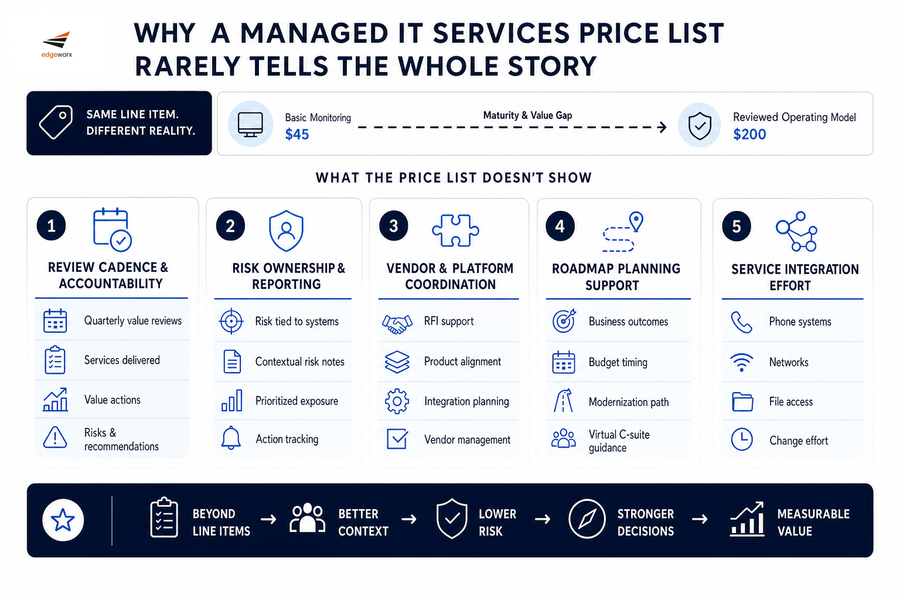
A managed IT services price list helps compare line items, yet it doesn’t show maturity, governance, vendor coordination, risk exposure, review cadence, or decision support. The same endpoint line can represent basic monitoring or a reviewed operating model, and MSSP pricing shows that gap, from $45 to $200.
-
Review cadence and accountability
Our managed service clients receive a documented quarterly value review covering services delivered, value actions, risks, and recommendations. If we don’t deliver that review, the client receives an extra executive review session at no charge, with exclusions for client scheduling delays, incomplete client data, or missed meetings.
-
Risk ownership and reporting
Leaders need risk notes tied to systems, tickets, approvals, and operational impact, not vague status updates.
-
Vendor and platform coordination
RFI support clarifies selected products and services before teams commit budget.
-
Roadmap planning support
Virtual C-suite guidance links modernization decisions to budget timing, operating priorities, and scaling needs.
-
Service integration effort
Phone systems, networks, file access, identity tools, and customer channels all change the work required to keep service stable.
Plan Your Managed IT Spend
How Much Does Managed IT Services Cost When AI And Phone Workflows Are Included
The cost of managed cybersecurity shifts when automated threat intelligence and AI-driven security workflows are integrated. Managed Security & AI Threat Detection services combine automated anomaly analysis, sentiment and communication monitoring, content gap checks in threat feeds, and direct integration with your security ecosystem.
-
Threat Intelligence Fit: We connect AI-driven threat monitoring directly into your incident response queues and containment protocols.
-
Behavioral & Sentiment Review: Continuous reviews flag anomalous user behaviors, credential abuse, or suspicious external communications.
-
Coverage Gap Identification: Uncovered attack vectors and missing log sources become structured remediation tasks.
-
Operational Control: Security leaders gain clear visibility into threat containment times, false-positive reductions, and recurring vulnerability trends.
Measurement turns the engagement into a management discipline rather than a technology experiment. Monthly response reviews, sentiment checks, content gap analysis, phone system integration.
Using A Managed IT Services ROI Calculator Without Oversimplifying Value
A managed IT services ROI calculator should capture avoided rework, faster approvals, fewer unresolved issues, stronger risk visibility, and cleaner executive reporting. For context, one Forrester analysis found benefits of $913,000 over three years versus costs of $282,000.
-
Ticket trends and effort: Track repeat tickets by system, location, and root cause.
-
Security risk reduction: Show which risks moved, who owns them, and what remains.
-
Customer response quality: Include phone queues, AI responses, sentiment findings, and recurring call topics.
-
Approval and invoice clarity: Match work performed to approved scope.
-
Roadmap readiness: Use assessments to guide modernization and efficient scaling.
-
Executive review visibility: Use quarterly reviews to give leaders evidence, not filler.
Building A Managed IT Services Calculator That Reflects Real Work
A managed IT services calculator is only as accurate as the inputs behind it. Clean inputs reduce pricing surprises, especially when IDC found 59% of cloud buyers anticipated similar overruns in 2024, while cyber insurance pricing was up just 1 percent.
-
Count the environment: Users, locations, devices, applications, servers, and network gear.
-
Map critical workflows: Phones, payments, dispatch, approvals, invoices, and customer calls.
-
List obligations: Privacy, accessibility, governance, and regulatory needs.
-
Capture vendor dates: Contracts, renewals, support terms, licensing owners, and approval paths.
-
Use RFI support: Request product, service, and pricing details for selected solutions so evaluation stays transparent.
Clarify Your IT Budget
See how Edgeworx Solutions connects managed IT pricing to scope, risk, reviews, and day-to-day operations.
Reducing Managed IT Costs Through Better Governance And Reviews
Reducing security spend isn’t about cutting protection—it comes from eliminating redundant security tools, overlapping software agent overhead, uncoordinated incident responses, and reactive patching. Our governance, cybersecurity, and vCISO advisory services deliver maximum value when reviews directly connect security spend to risk reduction.
-
Tool Redundancy Eliminated: Quarterly reviews identify overlapping security applications, unmanaged endpoints, and unused software licenses.
-
Documented Risk Decisions: Cybersecurity becomes a practical risk management conversation with concrete actions, clear owners, and hard completion dates.
-
Threat Surface Mitigation: Regular vulnerability reviews show where system exposure is highest and prioritize remediation.
-
Strategic Roadmaps: Guidance helps leaders schedule security infrastructure updates systematically instead of reacting to emerging threats.
-
Defensible Spend: Executive leadership and finance teams gain clear visibility into why specific security investments are required.
What To Ask Before You Compare Providers
Procurement gets easier when proposals are compared by operating responsibility, not just monthly cost.
-
Who owns recurring risk review and reporting for specific systems, endpoints, and workflows?
-
How are service actions documented for leadership, finance, and the internal IT team?
-
How are phone systems, AI workflows, and customer channels supported when call volume rises?
-
How does the provider coordinate with existing vendors, contracts, renewals, and RFI requests?
-
What happens when roadmap priorities change after a budget cycle starts?
-
How are recommendations separated from unnecessary purchases?
Talk Through Managed IT Services Pricing With Edgeworx Solutions
Pricing should give leaders confidence around service scope, risk ownership, customer responsiveness, and executive visibility, not just a cleaner invoice. As a security-first managed services partner, Edgeworx Solutions helps modernize technology, protect operations, and support growth through strategic leadership and practical execution.
Bring us your scope, priorities, and pricing inputs. We’ll talk through the work clearly, from invoice questions to phone queue pressure, so the next decision is easier to defend.