



Table of Contents
A city clerk opens overnight support requests while the technology team handles cloud access issues, aging laptops, and an audit evidence request due by noon. People are waiting on systems and approvals while customer responses, invoices, and service continuity depend on follow-through. Managed IT gives those moving parts named owners, agreed workflows, and reviewable evidence.
The benefits of managed IT services now sit inside wider resilience planning, with managed services a strategic focus for 99 percent of organizations and cybersecurity cited by 60% as the top MSP driver.
Paul Pagani, CISO, vCISO, Cybersecurity Expert at Edgeworx Solutions, notes: “The practical value starts when recurring tickets, access decisions, backups, and vendor escalations have named owners, documented evidence, and review dates leaders can act on.”
Benefits Of Managed IT Services Start With Visible Ownership
The first gain is clarity where work gets stuck. A printer outage in finance, a new-hire access request, or a recurring application error should not depend on who remembers last month’s fix. Mature agreements define scope and responsibilities. They also set service levels, escalation paths, and reporting expectations so managed IT services benefits show up as shared execution instead of loose handoffs. Key examples of this include:
-
Clear escalation paths: Staff know whether the issue goes to internal IT, the managed provider, or a software vendor.
-
Stronger ticket history: Fixes, approvals, and recurring symptoms stay attached to the record.
-
Proactive maintenance ownership: Patch windows, device health, and alerts have assigned follow-up.
-
Better leadership visibility: Risk, service trends, and unresolved items are reported before they become budget surprises.
The Importance Of Managed IT Services In Day To Day Continuity
Continuity depends on small checks that happen before staff arrive, customers call, or invoices queue for approval. Managed cloud services and network support reduce preventable disruption. Backup oversight, incident readiness, and application managed services keep ownership visible.
After a phone system issue, missed orders need more than a reset. The team needs to know whether calls failed, whether orders reached the application, and what changed before the lunch rush. Managed services advantages create value when technical follow-up connects directly to customer recovery work.
That same discipline turns continuity from a reaction into an operating routine.
Core capability areas include monitoring, backup validation, patch management, and application support.
Managed IT Services Benefits Improve Security And Risk Visibility
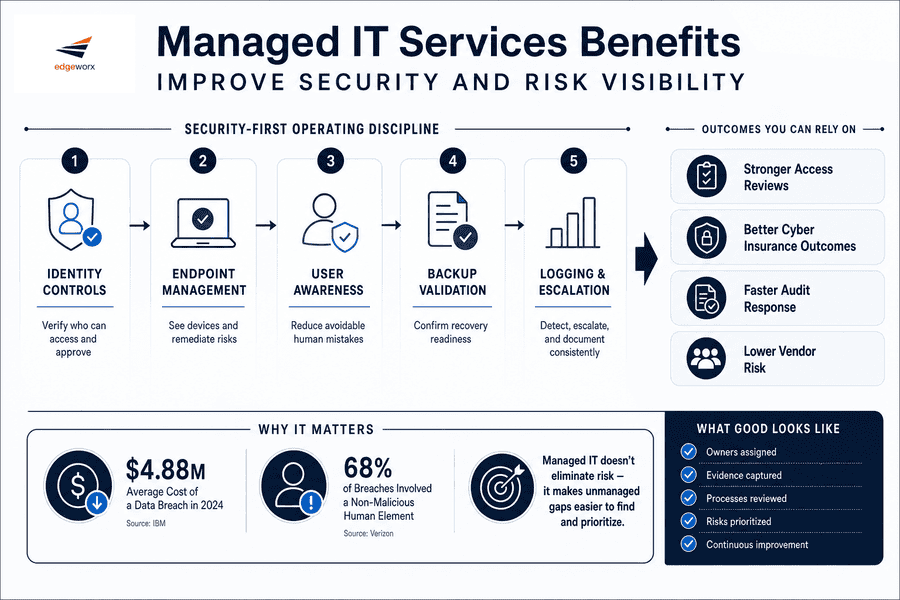
Security-first managed IT treats cybersecurity as a daily operating discipline. Identity controls confirm who can approve payments, endpoint management shows which laptops need attention, user awareness reduces avoidable mistakes, and backup validation supports recovery planning. Those managed IT benefits matter during access reviews, cyber insurance conversations, audit requests, and vendor risk meetings because leaders need evidence instead of assumptions.
Supported by provided research: IBM reported that the global average cost of a data breach reached $4.99 million in 2026, and Verizon reported that 68% of breaches involved a non-malicious human element.
The operational lesson is straightforward: endpoint protection, identity management, and logging need owners and evidence. Escalation discipline and user awareness also need clear review cycles. Managed IT does not remove risk, but it makes unmanaged gaps easier to find and prioritize.
Explore Managed IT Basics
Managed Services Advantages Show Up In Budgets And Planning
Technology budgets are easier to defend when costs connect to outcomes. Those outcomes include reliable licensing, secure cloud access, device replacement, and compliance evidence. They also include fewer stalled projects. Worldwide IT services spending reached $1.59 trillion in 2024, which makes planning discipline more important than broad line items. Managed IT services advantages help leaders decide what to renew, retire, standardize, or govern. They also keep privacy, accessibility, compliance, and risk priorities in view. Examples of this idea are:
-
Predictable managed service scope: Agreements define what is covered, how requests move, and where exceptions need approval.
-
Planned lifecycle replacement timing: Teams review aging endpoints and network gear before failures force rushed purchases.
-
Cloud cost governance reviews: Usage, licensing, and access policies are reviewed against actual needs.
-
Coordinated vendor issue ownership: Software, telecom, and infrastructure issues have a coordinated owner.
-
Executive reporting and guidance: Virtual CIO or virtual CISO guidance supports budget input, policy direction, compliance planning, and risk prioritization.
Clarify Your IT Ownership
Turn scattered tickets, access decisions, and risk reviews into accountable workflows with Edgeworx Solutions.
Managed IT Benefits Support Internal Teams Without Replacing Them
The importance of managed IT services is clearest when internal teams get capacity back for projects that keep waiting. Routine monitoring, service desk workflows, and documentation move through a shared operating model. Patching, backup checks, vendor coordination, and specialized work can also be shared while internal IT keeps business context and decision authority.
That change needs care because teams worry about control, trust, and accountability. Ticket queues, server access, and vendor relationships may have worked the same way for years. Key examples of this include:
-
Define service scope: Separate daily support, projects, security tasks, and approvals.
-
Map recurring pain points: Review repeat tickets, slow handoffs, and application issues.
-
Document escalation paths: Name owners for urgent, vendor, and leadership escalations.
-
Set review expectations: Use monthly reviews and documented quarterly value reviews to confirm progress, risks, and responsibilities.
Managed IT Services Advantages Deserve Clear Value Reviews
The benefits of managed IT services should be judged through uptime trends, response quality, cyber resilience, and compliance readiness. Buyers should also evaluate scope clarity, reporting quality, trust, and security alignment.
Edgeworx Solutions provides a documented quarterly value review for every managed service client. The review covers services delivered, value actions, risks, and recommendations. Readers can contact Edgeworx Solutions to discuss where managed services can improve daily operations.